Weekly Watchlist: IOVA(LN-145), CALC(Auxora), ANRO(ALTO-101)

Executive Summary
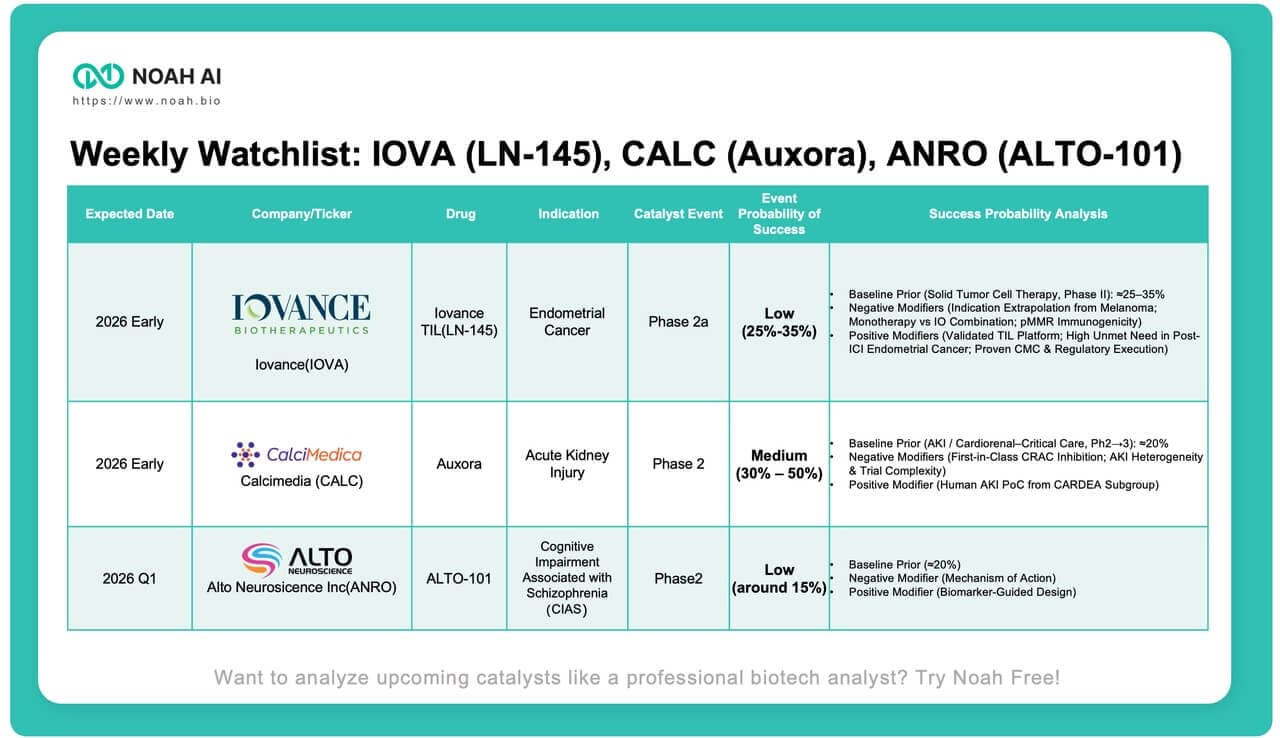
This week's watchlist highlights three upcoming Phase 2 catalysts across oncology, acute care, and CNS. Using a probability-weighted framework that combines historical phase-transition base rates with biology, mechanism, and trial-execution modifiers, we estimate the following probabilities of success:
-
CALC (Auxora, AKI Phase 2): ~30–50%
Best relative setup versus AKI peers, supported by human proof-of-concept, but still constrained by biology and execution risk. -
IOVA (LN-145 TIL, Endometrial Cancer Phase 2a): ~25–35%
Roughly in line with base rates for solid tumor cell therapies; the key swing factor is translation from melanoma to a less immunogenic tumor type. -
ANRO (ALTO-101, CIAS Phase 2): ~15%
Below-average odds for CNS programs; while biomarker-guided design helps, historical PDE4 translation risk remains dominant.
CALC (Auxora) — Acute Kidney Injury (Phase 2)
Estimated Probability of Success: ~30–50%
Relative Positioning: Above AKI Peers
-
Baseline Prior (Phase 2 → 3, Cardiorenal & Critical Care Indications): ~20–30%
- Based on benchmarks from related cardiorenal and critical care indications, including heart failure and acute kidney injury–adjacent syndromes, Phase 2–to–Phase 3 transition rates typically fall in the 20–30% range. Given the extreme heterogeneity and high mortality of the AKI + AHRF population, the appropriate baseline prior is likely at the lower end of this range.
-
Positive Modifier (Why >30%) – Human Proof-of-Concept in AKI
- The most important upside driver is the positive signal observed in the AKI subgroup of the CARDEA trial. While derived from a post hoc analysis, this represents direct human efficacy data that supports the scientific hypothesis underlying KOURAGE and differentiates it from other exploratory AKI programs relying solely on preclinical evidence.
-
Negative Modifiers (Why <50%) – AKI Biology and Trial Execution Risk
- Key uncertainties include the inherent risk of a first-in-class mechanism, the historically high failure rates in AKI drug development, and the substantial challenges of the KOURAGE trial itself, particularly in patient selection and endpoint design. Whether the CARDEA subgroup signal can be replicated in a broader, more heterogeneous non-COVID AKI population remains the central test.
IOVA (Iovance) — LN-145 TIL in Endometrial Cancer (Phase 2a)
Estimated Probability of Success: ~25–35%
Relative Positioning: In Line with Solid Tumor Cell Therapy Base Rates
-
Baseline Prior (≈25–35%)
- The historical Phase II success rate for solid tumor programs is approximately 30–40%. Given the added complexity and execution risk associated with cell therapies, the baseline probability is conservatively adjusted downward to 25–35%.
-
Negative Modifier (Indication Extrapolation & Treatment Design)
- The strong clinical efficacy of TIL therapy has been primarily demonstrated in melanoma, a highly immunogenic "hot tumor," often in combination with PD-1 inhibitors. In contrast, endometrial cancer—particularly pMMR disease—is more heterogeneous and less immunogenic, and the initial monotherapy design introduces uncertainty, warranting a downward adjustment.
-
Positive Modifiers (Platform Validation & Execution Capability)
- Robust melanoma data validate the TIL platform's biological activity, while the significant unmet need in the post-ICI setting and Iovance's proven CMC and regulatory execution, following the FDA approval of lifileucel, are expected to partially offset the negative modifiers and support an above-average probability of Phase II success.
ANRO (Alto Neuroscience) — ALTO-101 in CIAS (Phase 2)
Estimated Probability of Success: ~15%
Relative Positioning: Below CNS Averages
-
Baseline Prior (≈20%)
- The historical success rate for central nervous system (CNS) drugs transitioning from Phase 2 to Phase 3 is approximately 19-20%.
-
Negative Modifier (Mechanism of Action)
- The PDE4 inhibitor class, to which ALTO-101 belongs, has a history of demonstrating promising preclinical cognitive benefits that have failed to translate into convincing clinical efficacy in human trials. This historical challenge warrants a downward adjustment.
-
Positive Modifier (Biomarker-Guided Design)
- Alto is employing its precision psychiatry platform, using EEG-based theta inter-trial coherence (theta ITC) as a prospective biomarker and the study's primary endpoint. This innovative, biomarker-enriched trial design is intended to increase the probability of success and partially counteracts the negative modifier.
Disclosure: All analysis is conducted by Noah. This content is for informational purposes only and does not constitute investment or medical advice.